
2026 Request for Proposals
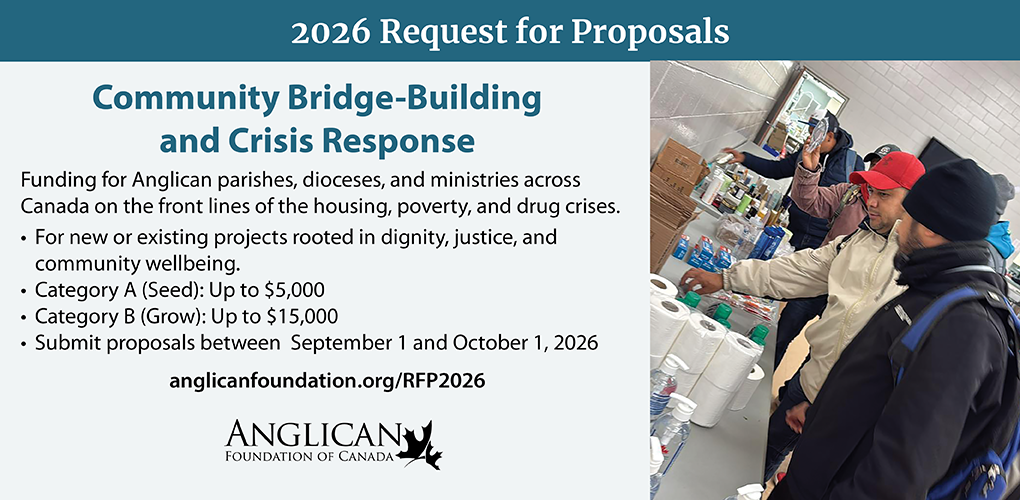
Highlights
- Applications Open: September 1, 2026
- Deadline: October 1, 2026
- Category A (Seed): Up to $5,000
- Category B (Grow): Up to $15,000
- For Anglican parishes, dioceses, deaneries, and recognized ministries
Across Canada, Anglican parishes are finding themselves on the front lines of the rising housing, poverty, and drug crises. This reality is affecting large cities, small towns, and rural and northern communities alike. Many churches are experiencing unprecedented levels of community need: unsheltered homelessness has increased 300% since 2018, overdose deaths continue to rise, and encampments are appearing in places where they have never been seen before. Behind these realities are people and communities navigating loss, resilience, and deep structural pressures.
Parishes are responding with compassion, creativity, and courage—often in the context of shared life with neighbours who are themselves navigating housing insecurity, addiction, poverty, and community strain. This work takes many forms: sharing food and warmth, offering presence and advocacy, providing practical supports, and walking alongside individuals, families, and community partners including municipalities, Indigenous leaders, health and social service organizations, shelters, street-outreach teams, and peer-support groups. Yet many parishes find themselves stretched, under-resourced, or uncertain about their role, particularly as community tensions rise and the emotional toll on volunteers intensifies.
Bishop Anna Greenwood-Lee recently articulated this challenge in her December 2025 Faith Tides column. Reflecting on the national homelessness crisis, she writes that the Church must be aware of what constitutes “true love of neighbour.” Temporary, unsustainable responses—no matter how well-intentioned—are not enough. The Church is called to participate in community projects that prioritize dignity, safety, stability, and justice, not short-term measures that inadvertently perpetuate harm.
Her reflection echoes what AFC is hearing across the country:
- Churches cannot shoulder this crisis on their own
- Partnerships can support long-term sustainability
- Longer-term, coordinated, dignity-centered approaches are needed
- Rural and northern ministries face unique pressures due to limited services
- Congregations want support to respond faithfully and safely within their capacity
With these realities in mind, AFC proposes a 2026 RFP focused on Community Bridge-Building and Crisis Response.
The goal is to equip Anglican parishes and diocesan ministries with seed funding to initiate, or a larger grant to grow, projects that help address the complex realities associated with housing insecurity, poverty, mental health challenges, addiction, and community tension—always with a commitment to dignity, justice, and sustainable community wellbeing.
This work is grounded in the Gospel call to love our neighbour as ourselves. In the parable of the Good Samaritan (Luke 10:25–37), Jesus challenges us not only to respond with compassion, but to cross boundaries, share responsibility, and ensure the wounded neighbour’s ongoing care. Faithful response, in this telling, is not limited to immediate relief, but includes sustained accompaniment and partnership.
This RFP is also rooted in the Baptismal Covenant and the Marks of Mission of the Anglican Church of Canada, particularly the call to seek justice, respect the dignity of every human being, and respond to human need by loving service. As communities grapple with housing insecurity, addiction, mental health challenges, and poverty, AFC seeks to support ministries that embody these commitments.
Scripture also reminds us that faithful response is never one-directional. As the Apostle Paul writes, “the members of the body that seem to be weaker are indispensable,” and “if one member suffers, all suffer together with it” (1 Corinthians 12:22–26). Within the body of Christ, vulnerability is not a deficit to be managed but a shared condition that binds us to one another. This vision challenges any division between “helper” and “helped,” calling the Church instead into relationships of mutual dependence, humility, and care—where all are both givers and receivers of grace.
Funding will be awarded for new or existing projects that strengthen a parish or diocesan response to the housing, poverty, and drug crises in their local or regional context.
Eligible projects may address the following areas, where faithful response is rooted in relationship, accompaniment, and shared responsibility:
- Walking alongside individuals and households experiencing housing insecurity or unsheltered homelessness
- Strengthening community responses to food insecurity and displacement
- Accompaniment, care, and shared responsibility in relation to addiction, overdose response, and mental health challenges
- Initiatives that foster constructive engagement amid community conflict, neighbourhood tension, or encampment-related challenges
- Capacity-building for volunteers and community members, including trauma-informed care, de-escalation, and harm-reduction training
- Indigenous-led or culturally grounded approaches that reflect community knowledge, leadership, and cultural integrity
- Community re-integration initiatives that support belonging, connection, and stability
- Structural and safety enhancements that enable sustainable hospitality, shared space, and community presence
- Collaborative projects that strengthen dignity, stability, and equitable access to services
All applicants must:
- Fall under the umbrella of an Anglican parish, diocese, deanery
- Be endorsed by a diocesan bishop
Funding will prioritize projects that:
- Focus on community ministry rather than infrastructure (recognizing that some physical or safety-related improvements may be essential to enable dignified and sustainable community use of church spaces).
- Involve, or have the support of, an external community partner—recognizing that partnerships may be formal or informal, and shaped by local context.
- Demonstrate mission alignment and a shared approach to program delivery
The AFC Board will approve grants in November 2026 under the following categories:
- Category A (Seed): Up to $5,000
- Category B (Grow): Up to $15,000
AFC may fund up to 100% of Category A project budgets and up to 50% of Category B budgets. Priority will be given to first-time RFP applicants if requests exceed available funds.
AFC recognizes that many of the challenges addressed through this RFP are complex, interconnected, and evolving. For this reason, grant recipients will be invited to participate in one or more online conversations during the 2027 program year with other grant recipients doing similar work.
These gatherings will provide space to:
- Share learnings, challenges, and emerging practices
- Reflect together on what is working in different contexts
- Strengthen cross-diocesan relationships
- Contribute to AFC’s understanding of effective, faith-based community responses
Where appropriate, participants may be grouped by area of focus (for example, food security, addiction and mental health supports, rural or northern contexts) to support meaningful exchange.
Participation is intended to be supportive and generative, not burdensome. AFC anticipates that this shared learning will help strengthen recipient ministries, reduce isolation, and inform future grant making and program development across the Church.
*AFC will approach communications and shared learning with sensitivity to local safety, privacy, and visibility concerns.
The AFC Board of Directors will review proposals in November 2026 and announce the grant recipients in early December. Proposals submitted in response to this request do not count as one of the four submissions each diocese is allowed per year.
All submissions must be made by using the online application form which will be published in early August.
For questions or to inquire about grant facilitation support please contact: [email protected].
 Due to the Canada Post strike, we will be sending tax receipts by email (in PDF format). Where we do not currently have email addresses for donors, we will be reaching out by phone to obtain one.